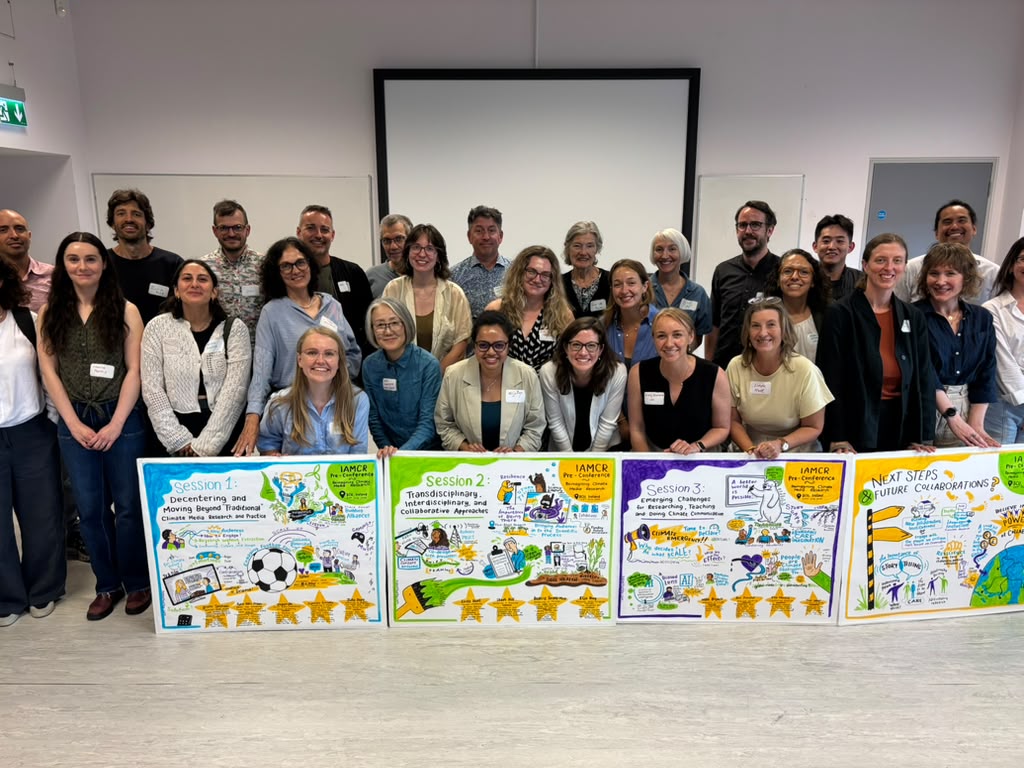
Co-organised by the IAMCR Environment, Science, and Risk Communication Section and the Climate Social Science Network (CSSN) Working Group on Critical Studies of Climate Media, Discourse, and Power, this pre-conference—co-organised by Dr Marc Esteve del Valle, Director of the EcoMediaLab—brought together scholars and practitioners working across climate change communication to reflect on where the field has been, where it stands now, and where it might be heading.

Framed by IAMCR’s conference theme, Peripheries and Connections: Media, Communication, and Transformation, the event created a space for dialogue across career stages, disciplines, and geographical contexts. Rather than treating climate media research as a settled field, participants approached it as an evolving and uneven landscape shaped by shifting epistemologies, institutional constraints, and global power relations.

A central thread running through the discussions was the need to move beyond established academic boundaries. Participants reflected on how climate media research can become more collaborative and practice-oriented, opening up space for contributions from NGOs, activists, journalists, and community organisers alongside traditional scholarly work. This emphasis on co-production was closely linked to questions of relevance and impact beyond the university, and to the importance of building more sustained partnerships across academic and non-academic spheres.

Another key insight concerned the persistent inequalities shaping climate communication research. Discussions highlighted the importance of recentring peripheralised voices and perspectives, particularly from less-studied geographical contexts, and of addressing the uneven distribution of resources and visibility between the Global North and Global South. Participants also stressed that collaboration is not only a methodological choice but a political and relational practice, requiring time, trust, and long-term commitment, especially in contexts of limited funding and institutional precarity.

Narratives and storytelling emerged as a further focal point. Participants reflected on how climate futures are constructed through stories—what is included, what is left out, and how “story gaps” shape both public understanding and academic work. This led to broader questions about whose voices are heard in climate discourse, and how researchers might better engage with communities that feel distant from or excluded from climate change debates.

The conversations also turned inward, towards the research community itself. Participants emphasised the importance of reflexivity, recognising researchers’ own positionalities, assumptions, and institutional constraints. There was a shared sense that more participatory and decolonial approaches are needed not only in research outputs, but within academic practice itself.

Finally, the pre-conference opened up reflections on the infrastructures of knowledge production. Alongside established networks such as IAMCR and CSSN, participants discussed the need to strengthen existing collaborations while also imagining new forms of organisation beyond traditional university structures. This included attention to language barriers, publishing norms, and the uneven accessibility of academic spaces.


Research
Coan, T., Malla, R., Nanko, M.O, Kattrup, W., Roberts J.T., Cook, J. and Boussalis, C.

Abstract

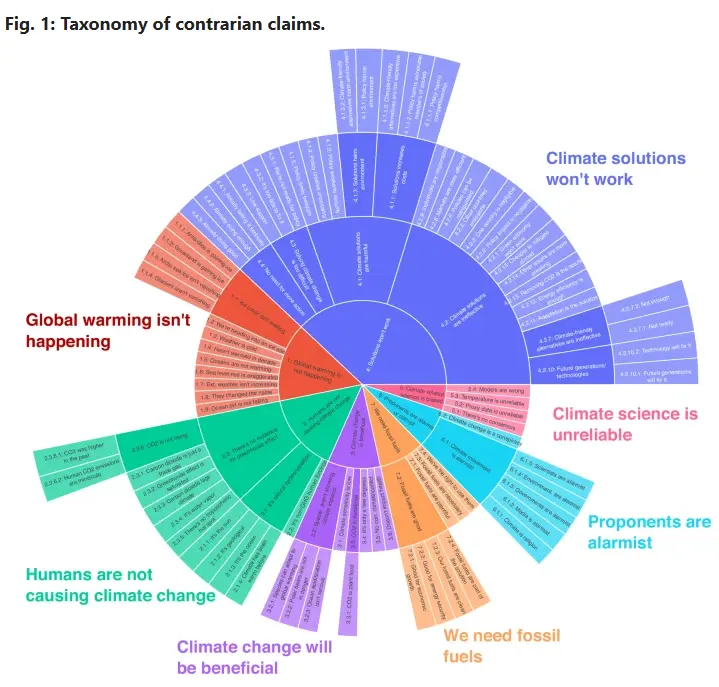
Using 30 years of Congressional floor speeches (1994–2023), we built an AI-powered system to track how — and how often — members of Congress push back on climate science and policy. A few highlights: 🔬 Updated CARDS taxonomy: We revised and extended the CARDS framework (Coan et al., 2021) to better capture solutions-focused skepticism and explicitly link contrarian claims to the “discourses of delay” identified by Lamb et al. (2020) — bridging two major frameworks in the climate communication literature. ⚙️ New method — RECoT fine-tuning: We introduce Reverse Engineered Chain-of-Thought (RECoT) fine-tuning, a procedure that teaches a smaller, scalable model to “reason” through complex, multi-label classification tasks. The result: near frontier-model accuracy at roughly 1/10th the cost — making large-scale claims classification feasible. 📊 Key findings: • Republicans are ~12x more likely than Democrats to make contrarian claims in floor speeches. • “Solutions increase costs” accounts for roughly one-third of all contrarian claims. • Contrarian speech has spiked around major climate policy moments (1997, 2009, 2015), surged during the Biden era, and was driven by a dramatic increase in discourses of delay. • More conservative Republicans, younger members, and those representing fossil fuel-dependent districts are significantly more likely to make contrarian claims.
Research
Coan, T., Malla, R., Nanko, M.O, Kattrup, W., Roberts J.T., Cook, J. and Boussalis, C.

Abstract

Using 30 years of Congressional floor speeches (1994–2023), we built an AI-powered system to track how — and how often — members of Congress push back on climate science and policy. A few highlights: 🔬 Updated CARDS taxonomy: We revised and extended the CARDS framework (Coan et al., 2021) to better capture solutions-focused skepticism and explicitly link contrarian claims to the “discourses of delay” identified by Lamb et al. (2020) — bridging two major frameworks in the climate communication literature. ⚙️ New method — RECoT fine-tuning: We introduce Reverse Engineered Chain-of-Thought (RECoT) fine-tuning, a procedure that teaches a smaller, scalable model to “reason” through complex, multi-label classification tasks. The result: near frontier-model accuracy at roughly 1/10th the cost — making large-scale claims classification feasible. 📊 Key findings: • Republicans are ~12x more likely than Democrats to make contrarian claims in floor speeches. • “Solutions increase costs” accounts for roughly one-third of all contrarian claims. • Contrarian speech has spiked around major climate policy moments (1997, 2009, 2015), surged during the Biden era, and was driven by a dramatic increase in discourses of delay. • More conservative Republicans, younger members, and those representing fossil fuel-dependent districts are significantly more likely to make contrarian claims.
Research
Coan, T., Malla, R., Nanko, M.O, Kattrup, W., Roberts J.T., Cook, J. and Boussalis, C.

Abstract

Using 30 years of Congressional floor speeches (1994–2023), we built an AI-powered system to track how — and how often — members of Congress push back on climate science and policy. A few highlights: 🔬 Updated CARDS taxonomy: We revised and extended the CARDS framework (Coan et al., 2021) to better capture solutions-focused skepticism and explicitly link contrarian claims to the “discourses of delay” identified by Lamb et al. (2020) — bridging two major frameworks in the climate communication literature. ⚙️ New method — RECoT fine-tuning: We introduce Reverse Engineered Chain-of-Thought (RECoT) fine-tuning, a procedure that teaches a smaller, scalable model to “reason” through complex, multi-label classification tasks. The result: near frontier-model accuracy at roughly 1/10th the cost — making large-scale claims classification feasible. 📊 Key findings: • Republicans are ~12x more likely than Democrats to make contrarian claims in floor speeches. • “Solutions increase costs” accounts for roughly one-third of all contrarian claims. • Contrarian speech has spiked around major climate policy moments (1997, 2009, 2015), surged during the Biden era, and was driven by a dramatic increase in discourses of delay. • More conservative Republicans, younger members, and those representing fossil fuel-dependent districts are significantly more likely to make contrarian claims.
Research
Coan, T., Malla, R., Nanko, M.O, Kattrup, W., Roberts J.T., Cook, J. and Boussalis, C.

Abstract

Using 30 years of Congressional floor speeches (1994–2023), we built an AI-powered system to track how — and how often — members of Congress push back on climate science and policy. A few highlights: 🔬 Updated CARDS taxonomy: We revised and extended the CARDS framework (Coan et al., 2021) to better capture solutions-focused skepticism and explicitly link contrarian claims to the “discourses of delay” identified by Lamb et al. (2020) — bridging two major frameworks in the climate communication literature. ⚙️ New method — RECoT fine-tuning: We introduce Reverse Engineered Chain-of-Thought (RECoT) fine-tuning, a procedure that teaches a smaller, scalable model to “reason” through complex, multi-label classification tasks. The result: near frontier-model accuracy at roughly 1/10th the cost — making large-scale claims classification feasible. 📊 Key findings: • Republicans are ~12x more likely than Democrats to make contrarian claims in floor speeches. • “Solutions increase costs” accounts for roughly one-third of all contrarian claims. • Contrarian speech has spiked around major climate policy moments (1997, 2009, 2015), surged during the Biden era, and was driven by a dramatic increase in discourses of delay. • More conservative Republicans, younger members, and those representing fossil fuel-dependent districts are significantly more likely to make contrarian claims.
Research
Coan, T., Malla, R., Nanko, M.O, Kattrup, W., Roberts J.T., Cook, J. and Boussalis, C.

Abstract

Using 30 years of Congressional floor speeches (1994–2023), we built an AI-powered system to track how — and how often — members of Congress push back on climate science and policy. A few highlights: 🔬 Updated CARDS taxonomy: We revised and extended the CARDS framework (Coan et al., 2021) to better capture solutions-focused skepticism and explicitly link contrarian claims to the “discourses of delay” identified by Lamb et al. (2020) — bridging two major frameworks in the climate communication literature. ⚙️ New method — RECoT fine-tuning: We introduce Reverse Engineered Chain-of-Thought (RECoT) fine-tuning, a procedure that teaches a smaller, scalable model to “reason” through complex, multi-label classification tasks. The result: near frontier-model accuracy at roughly 1/10th the cost — making large-scale claims classification feasible. 📊 Key findings: • Republicans are ~12x more likely than Democrats to make contrarian claims in floor speeches. • “Solutions increase costs” accounts for roughly one-third of all contrarian claims. • Contrarian speech has spiked around major climate policy moments (1997, 2009, 2015), surged during the Biden era, and was driven by a dramatic increase in discourses of delay. • More conservative Republicans, younger members, and those representing fossil fuel-dependent districts are significantly more likely to make contrarian claims.
Research
Coan, T., Malla, R., Nanko, M.O, Kattrup, W., Roberts J.T., Cook, J. and Boussalis, C.

Abstract

Using 30 years of Congressional floor speeches (1994–2023), we built an AI-powered system to track how — and how often — members of Congress push back on climate science and policy. A few highlights: 🔬 Updated CARDS taxonomy: We revised and extended the CARDS framework (Coan et al., 2021) to better capture solutions-focused skepticism and explicitly link contrarian claims to the “discourses of delay” identified by Lamb et al. (2020) — bridging two major frameworks in the climate communication literature. ⚙️ New method — RECoT fine-tuning: We introduce Reverse Engineered Chain-of-Thought (RECoT) fine-tuning, a procedure that teaches a smaller, scalable model to “reason” through complex, multi-label classification tasks. The result: near frontier-model accuracy at roughly 1/10th the cost — making large-scale claims classification feasible. 📊 Key findings: • Republicans are ~12x more likely than Democrats to make contrarian claims in floor speeches. • “Solutions increase costs” accounts for roughly one-third of all contrarian claims. • Contrarian speech has spiked around major climate policy moments (1997, 2009, 2015), surged during the Biden era, and was driven by a dramatic increase in discourses of delay. • More conservative Republicans, younger members, and those representing fossil fuel-dependent districts are significantly more likely to make contrarian claims.
Research
Coan, T., Malla, R., Nanko, M.O, Kattrup, W., Roberts J.T., Cook, J. and Boussalis, C.

Abstract

Using 30 years of Congressional floor speeches (1994–2023), we built an AI-powered system to track how — and how often — members of Congress push back on climate science and policy. A few highlights: 🔬 Updated CARDS taxonomy: We revised and extended the CARDS framework (Coan et al., 2021) to better capture solutions-focused skepticism and explicitly link contrarian claims to the “discourses of delay” identified by Lamb et al. (2020) — bridging two major frameworks in the climate communication literature. ⚙️ New method — RECoT fine-tuning: We introduce Reverse Engineered Chain-of-Thought (RECoT) fine-tuning, a procedure that teaches a smaller, scalable model to “reason” through complex, multi-label classification tasks. The result: near frontier-model accuracy at roughly 1/10th the cost — making large-scale claims classification feasible. 📊 Key findings: • Republicans are ~12x more likely than Democrats to make contrarian claims in floor speeches. • “Solutions increase costs” accounts for roughly one-third of all contrarian claims. • Contrarian speech has spiked around major climate policy moments (1997, 2009, 2015), surged during the Biden era, and was driven by a dramatic increase in discourses of delay. • More conservative Republicans, younger members, and those representing fossil fuel-dependent districts are significantly more likely to make contrarian claims.
Research
Coan, T., Malla, R., Nanko, M.O, Kattrup, W., Roberts J.T., Cook, J. and Boussalis, C.

Abstract

Using 30 years of Congressional floor speeches (1994–2023), we built an AI-powered system to track how — and how often — members of Congress push back on climate science and policy. A few highlights: 🔬 Updated CARDS taxonomy: We revised and extended the CARDS framework (Coan et al., 2021) to better capture solutions-focused skepticism and explicitly link contrarian claims to the “discourses of delay” identified by Lamb et al. (2020) — bridging two major frameworks in the climate communication literature. ⚙️ New method — RECoT fine-tuning: We introduce Reverse Engineered Chain-of-Thought (RECoT) fine-tuning, a procedure that teaches a smaller, scalable model to “reason” through complex, multi-label classification tasks. The result: near frontier-model accuracy at roughly 1/10th the cost — making large-scale claims classification feasible. 📊 Key findings: • Republicans are ~12x more likely than Democrats to make contrarian claims in floor speeches. • “Solutions increase costs” accounts for roughly one-third of all contrarian claims. • Contrarian speech has spiked around major climate policy moments (1997, 2009, 2015), surged during the Biden era, and was driven by a dramatic increase in discourses of delay. • More conservative Republicans, younger members, and those representing fossil fuel-dependent districts are significantly more likely to make contrarian claims.