Misinformation about climate change is no longer just about outright denial. It has evolved into a set of subtle tactics designed to slow down climate action. On June 18th, our lab presented the Climate Disinformation Bingo, an interactive workshop designed to help participants recognize and counter common disinformation techniques. The workshop was organized and presented by Marc Esteve del Valle and Mariana Chaves (University of Groningen). The activity blended knowledge sharing with practical exercises and provided participants with practical tools to identify tactics used by the climate change counter-movement. The bingo format, originally developed by Roberta Bosu and Stefano Cisternino, made the learning process both accessible and memorable, as attendees explored how these tactics appear in real news headlines. This workshop was part of the New Energy Forum 2026. 

If you are interested in bringing a Climate Disinformation workshop to your institution or community, feel free to get in touch with us (m.esteve.del.valle@rug.nl)


Research
Coan, T., Malla, R., Nanko, M.O, Kattrup, W., Roberts J.T., Cook, J. and Boussalis, C.

Abstract

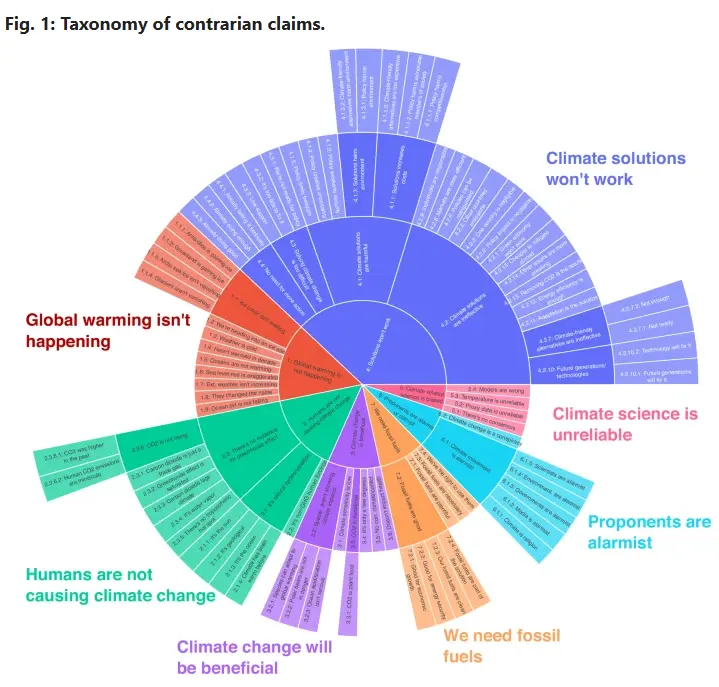
Using 30 years of Congressional floor speeches (1994–2023), we built an AI-powered system to track how — and how often — members of Congress push back on climate science and policy. A few highlights: 🔬 Updated CARDS taxonomy: We revised and extended the CARDS framework (Coan et al., 2021) to better capture solutions-focused skepticism and explicitly link contrarian claims to the “discourses of delay” identified by Lamb et al. (2020) — bridging two major frameworks in the climate communication literature. ⚙️ New method — RECoT fine-tuning: We introduce Reverse Engineered Chain-of-Thought (RECoT) fine-tuning, a procedure that teaches a smaller, scalable model to “reason” through complex, multi-label classification tasks. The result: near frontier-model accuracy at roughly 1/10th the cost — making large-scale claims classification feasible. 📊 Key findings: • Republicans are ~12x more likely than Democrats to make contrarian claims in floor speeches. • “Solutions increase costs” accounts for roughly one-third of all contrarian claims. • Contrarian speech has spiked around major climate policy moments (1997, 2009, 2015), surged during the Biden era, and was driven by a dramatic increase in discourses of delay. • More conservative Republicans, younger members, and those representing fossil fuel-dependent districts are significantly more likely to make contrarian claims.
Research
Coan, T., Malla, R., Nanko, M.O, Kattrup, W., Roberts J.T., Cook, J. and Boussalis, C.

Abstract

Using 30 years of Congressional floor speeches (1994–2023), we built an AI-powered system to track how — and how often — members of Congress push back on climate science and policy. A few highlights: 🔬 Updated CARDS taxonomy: We revised and extended the CARDS framework (Coan et al., 2021) to better capture solutions-focused skepticism and explicitly link contrarian claims to the “discourses of delay” identified by Lamb et al. (2020) — bridging two major frameworks in the climate communication literature. ⚙️ New method — RECoT fine-tuning: We introduce Reverse Engineered Chain-of-Thought (RECoT) fine-tuning, a procedure that teaches a smaller, scalable model to “reason” through complex, multi-label classification tasks. The result: near frontier-model accuracy at roughly 1/10th the cost — making large-scale claims classification feasible. 📊 Key findings: • Republicans are ~12x more likely than Democrats to make contrarian claims in floor speeches. • “Solutions increase costs” accounts for roughly one-third of all contrarian claims. • Contrarian speech has spiked around major climate policy moments (1997, 2009, 2015), surged during the Biden era, and was driven by a dramatic increase in discourses of delay. • More conservative Republicans, younger members, and those representing fossil fuel-dependent districts are significantly more likely to make contrarian claims.
Research
Coan, T., Malla, R., Nanko, M.O, Kattrup, W., Roberts J.T., Cook, J. and Boussalis, C.

Abstract

Using 30 years of Congressional floor speeches (1994–2023), we built an AI-powered system to track how — and how often — members of Congress push back on climate science and policy. A few highlights: 🔬 Updated CARDS taxonomy: We revised and extended the CARDS framework (Coan et al., 2021) to better capture solutions-focused skepticism and explicitly link contrarian claims to the “discourses of delay” identified by Lamb et al. (2020) — bridging two major frameworks in the climate communication literature. ⚙️ New method — RECoT fine-tuning: We introduce Reverse Engineered Chain-of-Thought (RECoT) fine-tuning, a procedure that teaches a smaller, scalable model to “reason” through complex, multi-label classification tasks. The result: near frontier-model accuracy at roughly 1/10th the cost — making large-scale claims classification feasible. 📊 Key findings: • Republicans are ~12x more likely than Democrats to make contrarian claims in floor speeches. • “Solutions increase costs” accounts for roughly one-third of all contrarian claims. • Contrarian speech has spiked around major climate policy moments (1997, 2009, 2015), surged during the Biden era, and was driven by a dramatic increase in discourses of delay. • More conservative Republicans, younger members, and those representing fossil fuel-dependent districts are significantly more likely to make contrarian claims.
Research
Coan, T., Malla, R., Nanko, M.O, Kattrup, W., Roberts J.T., Cook, J. and Boussalis, C.

Abstract

Using 30 years of Congressional floor speeches (1994–2023), we built an AI-powered system to track how — and how often — members of Congress push back on climate science and policy. A few highlights: 🔬 Updated CARDS taxonomy: We revised and extended the CARDS framework (Coan et al., 2021) to better capture solutions-focused skepticism and explicitly link contrarian claims to the “discourses of delay” identified by Lamb et al. (2020) — bridging two major frameworks in the climate communication literature. ⚙️ New method — RECoT fine-tuning: We introduce Reverse Engineered Chain-of-Thought (RECoT) fine-tuning, a procedure that teaches a smaller, scalable model to “reason” through complex, multi-label classification tasks. The result: near frontier-model accuracy at roughly 1/10th the cost — making large-scale claims classification feasible. 📊 Key findings: • Republicans are ~12x more likely than Democrats to make contrarian claims in floor speeches. • “Solutions increase costs” accounts for roughly one-third of all contrarian claims. • Contrarian speech has spiked around major climate policy moments (1997, 2009, 2015), surged during the Biden era, and was driven by a dramatic increase in discourses of delay. • More conservative Republicans, younger members, and those representing fossil fuel-dependent districts are significantly more likely to make contrarian claims.
Research
Coan, T., Malla, R., Nanko, M.O, Kattrup, W., Roberts J.T., Cook, J. and Boussalis, C.

Abstract

Using 30 years of Congressional floor speeches (1994–2023), we built an AI-powered system to track how — and how often — members of Congress push back on climate science and policy. A few highlights: 🔬 Updated CARDS taxonomy: We revised and extended the CARDS framework (Coan et al., 2021) to better capture solutions-focused skepticism and explicitly link contrarian claims to the “discourses of delay” identified by Lamb et al. (2020) — bridging two major frameworks in the climate communication literature. ⚙️ New method — RECoT fine-tuning: We introduce Reverse Engineered Chain-of-Thought (RECoT) fine-tuning, a procedure that teaches a smaller, scalable model to “reason” through complex, multi-label classification tasks. The result: near frontier-model accuracy at roughly 1/10th the cost — making large-scale claims classification feasible. 📊 Key findings: • Republicans are ~12x more likely than Democrats to make contrarian claims in floor speeches. • “Solutions increase costs” accounts for roughly one-third of all contrarian claims. • Contrarian speech has spiked around major climate policy moments (1997, 2009, 2015), surged during the Biden era, and was driven by a dramatic increase in discourses of delay. • More conservative Republicans, younger members, and those representing fossil fuel-dependent districts are significantly more likely to make contrarian claims.
Research
Coan, T., Malla, R., Nanko, M.O, Kattrup, W., Roberts J.T., Cook, J. and Boussalis, C.

Abstract

Using 30 years of Congressional floor speeches (1994–2023), we built an AI-powered system to track how — and how often — members of Congress push back on climate science and policy. A few highlights: 🔬 Updated CARDS taxonomy: We revised and extended the CARDS framework (Coan et al., 2021) to better capture solutions-focused skepticism and explicitly link contrarian claims to the “discourses of delay” identified by Lamb et al. (2020) — bridging two major frameworks in the climate communication literature. ⚙️ New method — RECoT fine-tuning: We introduce Reverse Engineered Chain-of-Thought (RECoT) fine-tuning, a procedure that teaches a smaller, scalable model to “reason” through complex, multi-label classification tasks. The result: near frontier-model accuracy at roughly 1/10th the cost — making large-scale claims classification feasible. 📊 Key findings: • Republicans are ~12x more likely than Democrats to make contrarian claims in floor speeches. • “Solutions increase costs” accounts for roughly one-third of all contrarian claims. • Contrarian speech has spiked around major climate policy moments (1997, 2009, 2015), surged during the Biden era, and was driven by a dramatic increase in discourses of delay. • More conservative Republicans, younger members, and those representing fossil fuel-dependent districts are significantly more likely to make contrarian claims.
Research
Coan, T., Malla, R., Nanko, M.O, Kattrup, W., Roberts J.T., Cook, J. and Boussalis, C.

Abstract

Using 30 years of Congressional floor speeches (1994–2023), we built an AI-powered system to track how — and how often — members of Congress push back on climate science and policy. A few highlights: 🔬 Updated CARDS taxonomy: We revised and extended the CARDS framework (Coan et al., 2021) to better capture solutions-focused skepticism and explicitly link contrarian claims to the “discourses of delay” identified by Lamb et al. (2020) — bridging two major frameworks in the climate communication literature. ⚙️ New method — RECoT fine-tuning: We introduce Reverse Engineered Chain-of-Thought (RECoT) fine-tuning, a procedure that teaches a smaller, scalable model to “reason” through complex, multi-label classification tasks. The result: near frontier-model accuracy at roughly 1/10th the cost — making large-scale claims classification feasible. 📊 Key findings: • Republicans are ~12x more likely than Democrats to make contrarian claims in floor speeches. • “Solutions increase costs” accounts for roughly one-third of all contrarian claims. • Contrarian speech has spiked around major climate policy moments (1997, 2009, 2015), surged during the Biden era, and was driven by a dramatic increase in discourses of delay. • More conservative Republicans, younger members, and those representing fossil fuel-dependent districts are significantly more likely to make contrarian claims.
Research
Coan, T., Malla, R., Nanko, M.O, Kattrup, W., Roberts J.T., Cook, J. and Boussalis, C.

Abstract

Using 30 years of Congressional floor speeches (1994–2023), we built an AI-powered system to track how — and how often — members of Congress push back on climate science and policy. A few highlights: 🔬 Updated CARDS taxonomy: We revised and extended the CARDS framework (Coan et al., 2021) to better capture solutions-focused skepticism and explicitly link contrarian claims to the “discourses of delay” identified by Lamb et al. (2020) — bridging two major frameworks in the climate communication literature. ⚙️ New method — RECoT fine-tuning: We introduce Reverse Engineered Chain-of-Thought (RECoT) fine-tuning, a procedure that teaches a smaller, scalable model to “reason” through complex, multi-label classification tasks. The result: near frontier-model accuracy at roughly 1/10th the cost — making large-scale claims classification feasible. 📊 Key findings: • Republicans are ~12x more likely than Democrats to make contrarian claims in floor speeches. • “Solutions increase costs” accounts for roughly one-third of all contrarian claims. • Contrarian speech has spiked around major climate policy moments (1997, 2009, 2015), surged during the Biden era, and was driven by a dramatic increase in discourses of delay. • More conservative Republicans, younger members, and those representing fossil fuel-dependent districts are significantly more likely to make contrarian claims.